


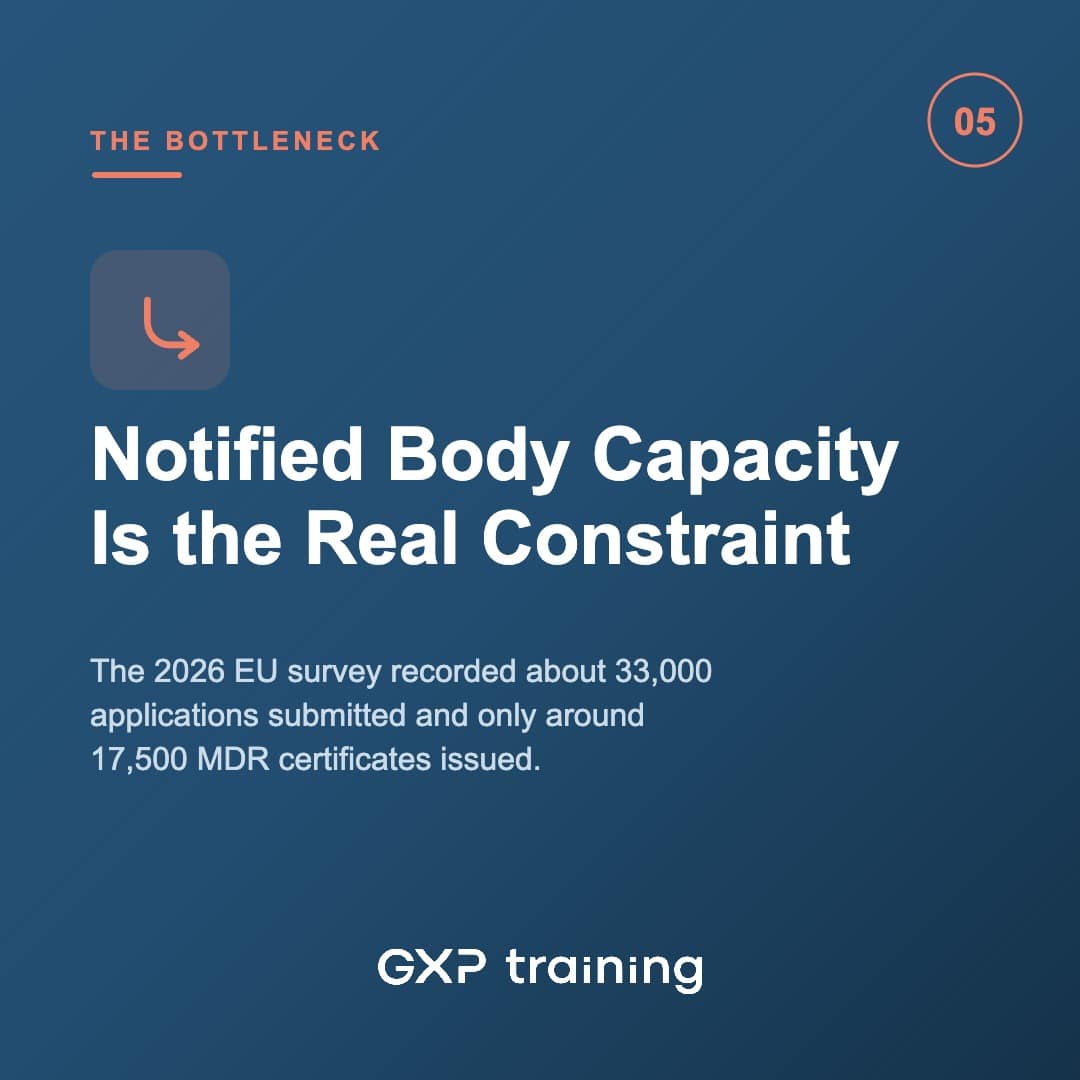
On 12 December 2025, the European Commission introduced a draft Implementing Regulation intended to standardize the timelines and procedural conduct of notified bodies performing conformity assessments under Regulation (EU) 2017/745. The proposal directly addresses long standing pain points: opaque pricing, unpredictable timelines, and variable re certification practices across notified bodies. Three months later, the Commission’s own data confirmed the scale of the problem it was trying to solve: the 18th Notified Bodies Survey, published in March 2026 with data through October 2025, showed 33,175 applications submitted to notified bodies against only 17,549 Medical Device Regulation (MDR) certificates issued, a gap that leaves thousands of devices waiting in a queue unlikely to clear before their certificates begin to lapse. That draft has since been adopted as Commission Implementing Regulation (EU) 2026/977, which will apply from 25 February 2027.
For manufacturers approaching the 31 December 2027 deadline, which applies to all Class III devices and Class IIb implantable devices, that backlog changes the calculus. A submission returned for deficiencies does not simply hold its place in the queue; it re-enters a system already straining to keep pace, and every month lost to rework is a month a device risks losing its lawful route to the European market. Notified body auditors increasingly treat a well-prepared regulatory and quality team as one of the clearest signals that a submission is ready the first time, and that shifts structured MDR training from a professional nicety to a risk-management necessity in the eyes of the people signing off on the file.
That backlog is not the only pressure building on manufacturers. Notified bodies increasingly expect a continuous state of control across the full device lifecycle, from conformity assessment through post-market surveillance, audited with a depth the directive era never required. For manufacturers who also sell into the United States, the FDA applies a parallel quality-system logic, so a team fluent in one framework still needs deliberate training in the other. Understanding where these expectations converge, and which roles carry them, is often the difference between a routine certificate transfer and a scramble that puts patient access at risk.


The Medical Device Regulation entered into force on 25 May 2017 and became applicable on 26 May 2021, replacing the older Medical Devices Directive and the Active Implantable Medical Devices Directive. Because notified body capacity could not absorb the volume of legacy devices in time, Regulation (EU) 2023/607 extended the transition, and it did so on a risk-graded schedule rather than a single cliff edge. Higher-risk devices face the earlier date: all Class III devices and Class IIb implantable devices, apart from a defined set of well-established technologies, must hold a valid MDR certificate by 31 December 2027. Class IIa devices, Class IIb non-implantable devices, and Class I devices that now require notified body involvement follow one year later, on 31 December 2028. Anyone planning re-training should map their portfolio against these dates first, because the calendar, not the topic, sets the priority.
The regulation did not simply rename the directive; it raised the evidentiary bar for clinical data, widened post-market obligations, and introduced traceability infrastructure that many quality teams had never operated before. A specialist who was fluent under the directive can still misjudge what a notified body now expects in a technical file, and that gap stays invisible until an audit exposes it.
The pressure is compounded by a certification bottleneck that has not fully cleared. Notified bodies are reporting that the average time between a lodged application and a successful MDR certification review now runs thirteen to eighteen months, and for complex devices it can extend well beyond that. A submission returned for deficiencies does not simply hold its place in the queue; it competes again for scarce review capacity, which is why the quality of a first submission now carries real commercial weight.
Re-training is only useful when it maps to the specific duties the regulation assigns, and a well-built MDR compliance training program is organized around exactly those duties rather than the text in the abstract. The obligations that most often demand fresh competence include the following:
What ties these obligations together is that a notified body auditor reads them as a system, not a checklist. An examiner who finds a weak clinical evaluation will look harder at post-market surveillance, and a gap in UDI records invites scrutiny of the whole technical file. Teams that understand the obligations only in isolation tend to answer individual questions well and still fail the auditor’s overall judgment of a controlled system.
The MDR 2017/745 training course from GxP Training is built to close exactly the competence gaps described above, translating the regulation into working knowledge that a professional can apply the same week. It was built by a team of Regulatory Affairs Experts with advanced qualifications and hands-on regulatory experience, and it is structured to move a learner from the scope of the regulation through to the practical mechanics of Eudamed and post-market surveillance.
Course Details
Detailed Curriculum Overview
Whether a professional is preparing for a first audit or refreshing directive-era knowledge, this certified MDR training gives an entire team a shared and current foundation. For groups that need adjacent competencies as well, the course sits inside the broader Medical Devices Learning Path, which extends the same rigor across quality management and related device regulations.
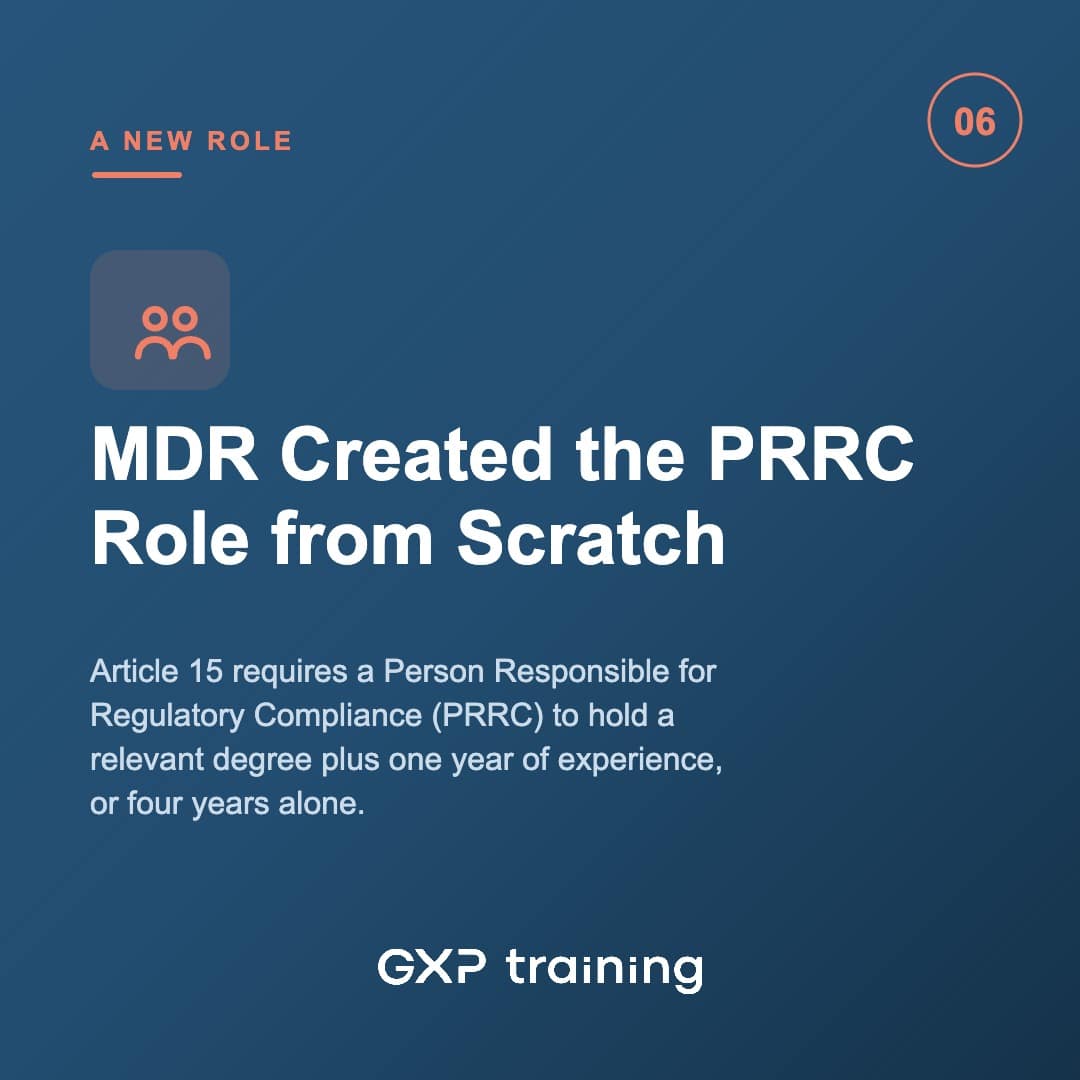
The reach of the regulation is wide enough that re-training rarely stops at a single desk. Regulatory affairs specialists sit closest to the change, since they own the technical documentation and the declaration of conformity that a notified body examines first, yet they depend on quality assurance managers to keep the underlying management system in a demonstrable state of control. The Person Responsible for Regulatory Compliance, a role the regulation created outright, needs the deepest command of the text, because Article 15 places personal accountability on that individual. Clinical affairs colleagues must understand why the evidentiary standard for clinical evaluation has risen and what that means for the studies they design. Post-market surveillance and vigilance officers inherit obligations that used to be intermittent and are now continuous. Design and research engineers must build identification and traceability requirements into products from the first sketch rather than retrofitting them later. Product managers who plan launch timelines cannot forecast honestly without knowing where their devices fall against the 2027 and 2028 dates. When those roles share a common foundation, hand-offs stop leaking risk and the organization begins to behave as one compliant system.
The cost of re-training is negligible next to the cost of missing a certificate window. A lapsed MDR certificate does not merely pause sales; it forces a device off the European market until a fresh conformity assessment is complete, and with notified body reviews frequently running thirteen to eighteen months or longer, the resulting gap can outlast a full budget cycle. Set against that exposure, the cost of preparing a team is minor by comparison, and the return is measured in avoided remediation, protected revenue, and the credibility a firm carries into its next audit. In advising manufacturers through MDR certificate transfers, I have seen partners and distributors increasingly ask for evidence of competence before terms are finalized, so a trained workforce signals reliability before a single technical question is asked. Investing ahead of the deadline converts a looming compliance liability into a defensible market position.
GxP Training builds its courses with regulatory practitioners rather than generalist content teams, so the material speaks to the decisions a professional actually faces instead of reciting the regulation back to them. Every completion earns a unique and verifiable certificate that is CPD and CEU accredited and can be shared directly on LinkedIn, giving individuals a portable credential and employers a traceable training record. Access runs for twelve months on a self-paced basis, so a learner can fit the material around live projects, and managers can follow progress and completion through built-in tools that feed cleanly into human resources and audit documentation. Content is refreshed as the regulatory picture shifts, the courses are SCORM compatible for organizations that prefer to host inside their own learning management system, and the same standard of rigor runs through every title in the catalog. For a compliance-critical subject like the Medical Device Regulation, that combination of expert authorship, verifiable certification, and maintained content is what separates training that ticks a box from MDR training that holds up under inspection.
The dates are fixed, the queue is real, and the roles that carry the regulation are already known. In every notified body audit I have sat through, the manufacturers who fared best were the ones who had treated their people, not just their paperwork, as part of the technical file. Preparing those roles now is the most controllable variable left before the transition closes, and it is the one most likely to keep a device lawfully on the market when it does.