

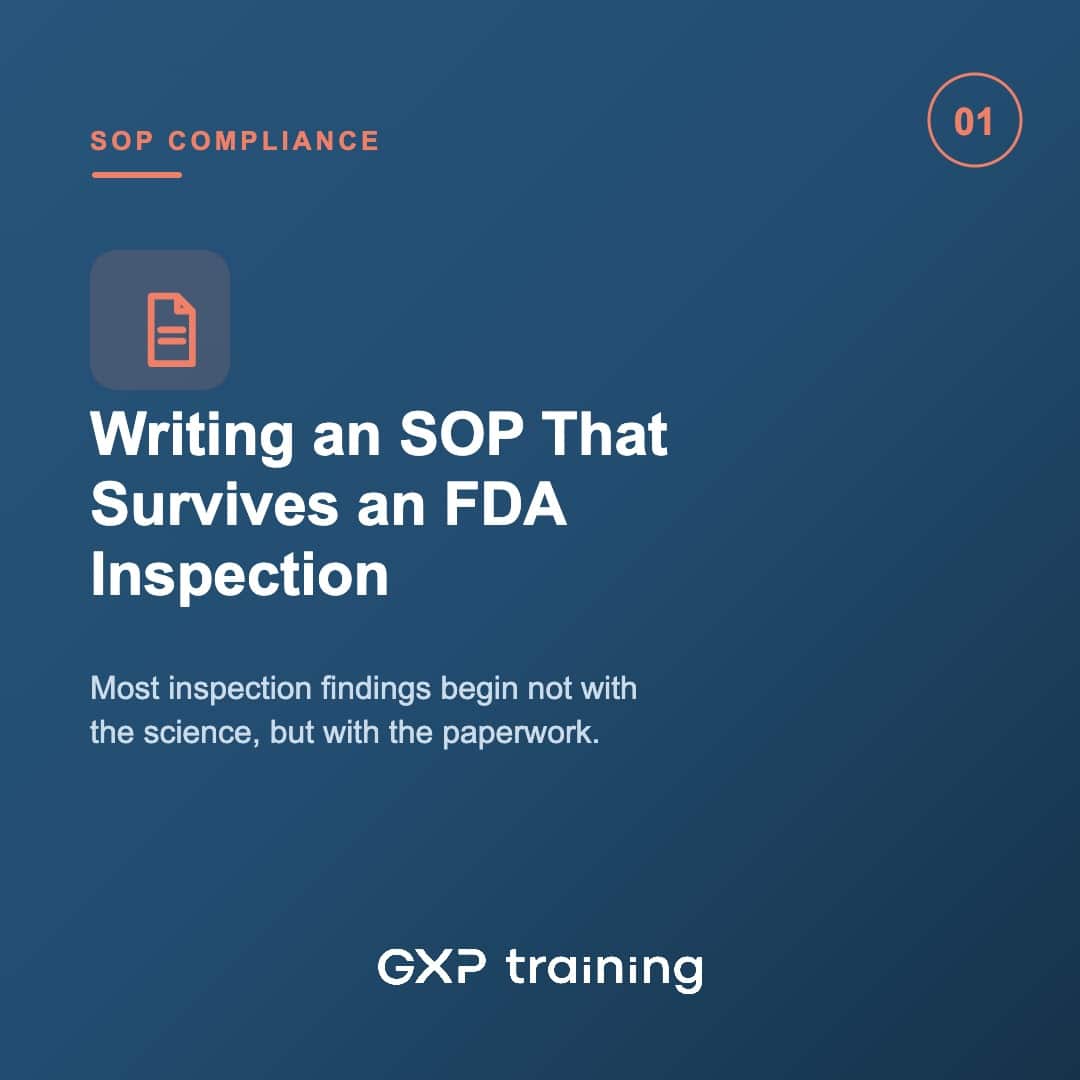
During one pre-approval inspection I supported, the investigator did not challenge our equipment or our analytical methods. She asked to see the procedure for a single cleaning step, then compared it against the record an operator had signed the week before. When the two do not match, that gap alone, a Standard Operating Procedure (SOP) that describes one practice while the batch record documents another, is often enough to seed a Form 483 observation and weeks of remediation. That is what disciplined Good Documentation Practice training protects against: the moment when what a team writes, what it does, and what it records stop matching each other.
Regulators are explicit about this expectation. Under 21 CFR 211.100, the FDA requires written procedures for production and process control, and it requires that those procedures be followed, with any deviation recorded and justified. In the European Union, Chapter 4 of the EudraLex Good Manufacturing Practice (GMP) guide sets parallel documentation expectations, and the EMA published a draft revision of that chapter in July 2025 that extends good documentation practice into hybrid paper and digital systems. Both agencies treat the SOP as evidence. When an investigator reads a procedure, they are asking one question: does this document prove the company is in a state of control? A procedure that cannot answer that question becomes a liability rather than a safeguard.
Most standard operating procedures do not fail because they are scientifically wrong. They fail because they are unusable at the moment that matters. A procedure written to satisfy an auditor two years ago, then never reconciled with how the work is actually performed, opens a gap between the paper and the practice. Investigators are trained to find that gap. Written production and process control procedures that are not followed, along with deviations that are neither recorded nor justified, sit among the most frequently cited findings in FDA drug inspections year after year, according to the agency’s own inspection data, and they map directly to 21 CFR 211.100.
The failure modes are consistent. A procedure references a form that no longer exists. It instructs staff to record a result promptly without defining when, which invites entries reconstructed from memory rather than captured at the time of the work. It carries no effective date, so no one can prove which version governed a given batch. Each of these is a documentation weakness before it is a scientific one, and each is preventable through disciplined Good Documentation Practice. When investigators pull a thread like this, they are not hunting for typos. They are testing whether the quality system can be trusted to mean what it says, a test that has only grown sharper as data governance expectations tighten in 2026.
A procedure that withstands scrutiny shares a recognizable structure. It removes ambiguity, it makes every action attributable, and it leaves a record that an investigator can follow without a guide. The FDA anchors its data integrity expectations to the ALCOA principle, set out in its 2018 guidance on data integrity and Current Good Manufacturing Practice (CGMP): records should be attributable, legible, contemporaneously recorded, original, and accurate. A well built procedure designs those attributes in from the first draft rather than adding them after a finding.
These attributes are the working vocabulary of Good Documentation Practices training, and they translate a policy on paper into behavior on the floor. The same ALCOA logic underpins pharmaceutical data integrity, the field where these habits are stress tested most, and it is closely tied to the discipline taught in a dedicated course on how to write effective Standard Operating Procedures. Teams that internalize these attributes tend to write shorter, clearer procedures, because clarity, not length, is what an investigator rewards.
When an investigator opens a batch record or a logbook, the checks are surprisingly consistent, and they rarely concern the science first. Is each entry signed and dated by the person who performed the work? Were results captured at the time of the activity, or does the ink tell a different story? When a mistake was corrected, is the original value still visible beneath a single line, or has it been obscured? Was a result recorded on the approved form, or on a scrap of paper and transcribed later? Each question maps to a documentation principle, and each is either codified in the GMP regulations or expected under agency guidance.
Contemporaneous recording deserves particular attention. The FDA developed its data integrity guidance in response to a rise in findings during recent inspection cycles, and that guidance is unambiguous that an activity must be documented when it happens, not hours later from memory. Backdating and late transcription are not clerical shortcuts to an investigator. They read as a failure of the record to represent reality. This is the terrain that structured Good Documentation Practice training prepares staff to navigate long before an inspector is in the building. The organizations that fare best treat every record as though it will be read aloud during an inspection, because eventually one of them will be.
The Good Documentation Practice (GDocP) course from GxP Training turns these principles into a practical, repeatable skill set. It walks clients through what good documentation practices are, how and when to apply them, the document types that make up a quality system, and the exact mechanics of completing records, adding raw data, correcting errors, and signing and dating entries so that each stands up to inspection. Structured as a focused module, this Good Documentation Practice training distills lessons that usually take years of inspection experience into a two hour path. The course was built by a team of Regulatory Affairs Experts with advanced qualifications and hands-on regulatory experience.
Course Details
Detailed Curriculum Overview
The reach of documentation discipline is wider than most teams assume. Quality assurance professionals own the SOP lifecycle and answer to the investigator directly, yet they depend on manufacturing operators who must record each step as it happens, and on laboratory analysts whose notebooks and raw data are examined line by line. Quality control reviewers sit between them, catching the missing signature or the ambiguous entry before an inspector does, while regulatory affairs specialists translate these records into submissions that agencies will accept. Even document control coordinators, who rarely touch a batch, hold the version histories that decide whether a procedure can be defended at all. Because a single weak link exposes the whole chain, and because inspections in 2026 probe records more deeply than before, each of these roles benefits from the shared language that Good Documentation Practice training provides.
In the 2026 market, the cost of weak documentation is no longer measured only in remediation hours. A single Form 483 that escalates to a warning letter can freeze approvals, delay a product launch, and trigger customer audits that consume a quality team for months. Against that exposure, a two hour course is a modest investment, negligible next to the six figure remediation that a serious inspection finding can set in motion. Documentation discipline also compounds quietly. Procedures that are clear the first time reduce deviations, shorten review cycles, and lower the training burden on every new hire. Buyers increasingly benchmark suppliers on inspection history, so a demonstrable state of control has become a commercial asset rather than a compliance cost.
GxP Training builds its courses with recognized experts in GMP, GLP, GCP, GDP, regulatory affairs, quality assurance, and pharmacovigilance, and it keeps every course current with annual updates so the guidance never drifts from the regulations it describes. Each client earns a unique, verifiable certificate that is CPD and CEU accredited and can be shared directly on LinkedIn, backed by an online checker that lets an auditor confirm it in seconds. Access runs for twelve months at a self paced rhythm, and managers can enroll a team, follow progress, send reminders, and collect audit-ready certifications through built in HR tools. For organizations that run a learning management system, courses export cleanly over SCORM, so the training fits existing infrastructure without friction.
The inspection I remember did not turn on a scientific failure. It turned on a sentence in a procedure that no longer matched the work. That is the quiet truth behind most findings, and it is also the reassuring one, because a documentation gap is something a team can close before an investigator ever arrives. An SOP survives an FDA inspection when the people who write it and the people who follow it share the same rigorous habits, and those habits can be taught. That is the whole premise of Good Documentation Practice training: to make the record tell the truth every time, so that when the investigator asks to see the procedure, the answer is already on the page.