


Life sciences teams work in environments where safety cannot be taken for granted. Whether handling chemical reagents, working with biological materials, or operating equipment under pressure, lab staff face real risks. This is why annual OSHA safety training isn’t something to overlook. Everyone needs to understand how to recognize hazards and follow the right steps to avoid them.
In this blog, we’ll break down whether annual OSHA safety training is necessary and how it applies to those working in GxP settings. You’ll also learn what counts as sufficient training, who should be involved, and how to make sure your program is up to date without adding unnecessary complexity.
OSHA sets the legal standard for workplace safety in the United States, and for those in the life sciences industry, that includes specific requirements related to laboratories, chemical handling, and biological exposure. The expectation is not simply that staff receive training once and move on. Instead, OSHA calls for regular instruction that keeps pace with changes in protocols, hazards, or responsibilities.
For lab-based environments covered under the OSHA Laboratory Standard (29 CFR 1910.1450), the need for training is ongoing. Staff must be trained at the time of initial assignment, whenever new hazards are introduced, and at regular intervals that ensure information remains fresh and actionable. This often leads to annual refresher training, not because it’s mandated on a yearly basis by OSHA, but because it’s a practical and effective way to remain compliant.
Keeping your lab teams safe goes far beyond handing out protective equipment. Our OSHA Lab Safety Certified Training course gives your staff practical tools and real knowledge they can apply every day. The program is built for life sciences settings, so the examples, exercises, and guidelines actually reflect the challenges your team faces.
You’ll learn how to spot hazards before they become problems, follow the right emergency procedures, and make sure that everyone in the lab knows their part in maintaining a safe environment. From handling chemicals to managing biological risks, this course walks you through it all in plain language that sticks.
When you finish the course, you receive a recognised certificate that demonstrates your commitment to OSHA standards and safety best practices.

Some of the benefits you’ll get:
Together, these tools help your staff feel prepared and supported in making safety part of everyday work. If you’d like help choosing the right training mix, contact our team and we’ll guide you in building a stronger safety culture from the ground up.
OSHA training in life sciences isn’t limited to lab technicians or research scientists. Many different roles come into contact with regulated environments, and each one requires some level of training to stay safe and compliant. It’s important to look beyond the obvious and consider the full range of people who enter or work near lab spaces.
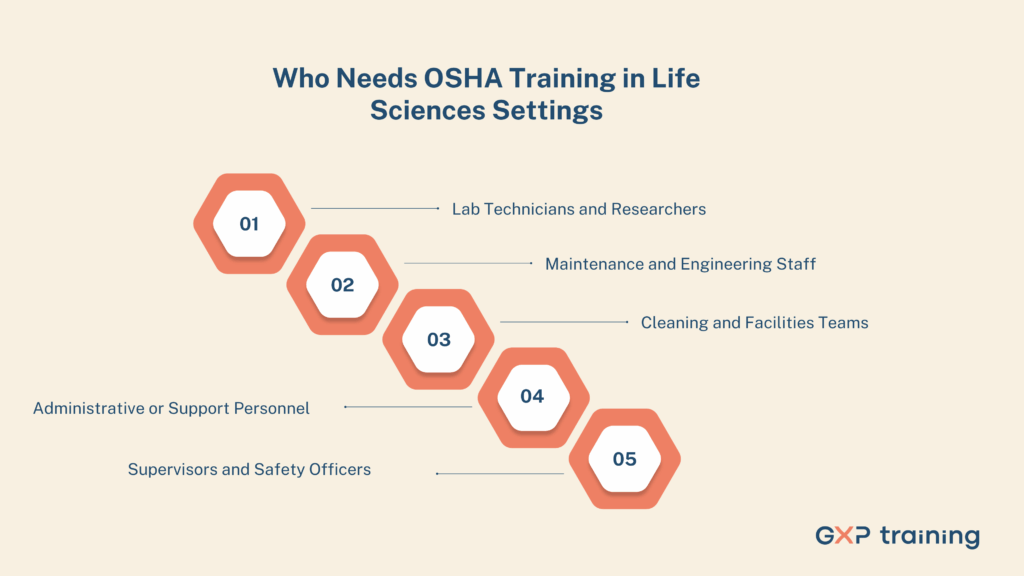
Some of the key groups who need OSHA safety training include:
These team members work directly with hazardous chemicals, biological samples, or complex equipment. Their training should cover personal protective equipment, emergency procedures, and safe handling protocols.
Even if they don’t handle lab materials themselves, they often work on or around equipment that poses risks. They need to understand contamination zones, safe shutdown processes, and how to avoid exposure.
Janitorial and sanitation staff are often near or inside lab environments. They should be trained on biohazard waste procedures, spill cleanup protocols, and safety signage.
Office staff, interns, or visiting managers who occasionally enter lab spaces should know how to navigate those areas safely. Basic training helps them recognize restricted zones, proper attire requirements, and emergency exit routes.
These roles require a deeper understanding of OSHA standards and how to enforce them. They should be equipped to oversee compliance, correct unsafe behavior, and lead emergency responses.
Providing each of these groups with the right level of training creates a stronger safety culture. When everyone understands the risks that apply to their role, it’s easier to avoid accidents and maintain compliance without adding confusion or delays.
In regulated environments like biotech labs, pharmaceutical facilities, or medical device development sites, safety isn’t something that can be addressed just once. The conditions, procedures, and materials involved in daily operations are always evolving. That’s why annual training plays a key role in reinforcing critical safety behaviors and updating staff on the latest protocols.
Repetition helps reduce complacency. When people see the same topics year after year, they’re more likely to remember procedures in high-pressure situations. Annual sessions are also the ideal time to review any near misses or incident reports from the past twelve months. These real-world lessons help staff understand how lapses can happen and what to do differently next time.
Beyond emergency response and hazard recognition, annual OSHA training also helps ensure that all staff are still aligned with the facility’s safety documentation, such as updated SOPs or revised equipment usage guidelines. This kind of routine learning fosters a culture of responsibility, where safety is treated as part of the job rather than something extra. When people expect training, they’re more likely to take it seriously, ask questions, and apply what they learn in practical ways.
Annual OSHA training for life sciences staff typically includes a set of recurring topics that help ensure everyone is up to date on essential practices. These areas are selected not just for regulatory compliance but to reduce risks in environments where chemicals, biological agents, sharp instruments, and specialized equipment are used regularly.
Training often includes hazard communication and labeling systems to make sure staff can quickly identify and respond to risks in their workspace. Personal protective equipment use is also reviewed, ensuring everyone understands which gear to use and how to wear it properly. Bloodborne pathogen awareness is another key topic, particularly in clinical or lab settings, where exposure to human materials is possible.
Other core elements include emergency response procedures, such as evacuation plans, spill handling, and eyewash or safety shower usage. Fire safety, electrical hazards, and ergonomics may also be covered, depending on the nature of the facility and the role of each employee. The goal is to deliver training that matches both general workplace standards and the specific hazards life sciences staff encounter in their day-to-day responsibilities.
Annual OSHA lab safety training keeps your team alert, compliant and ready to handle risks with confidence. When people know how to work safely, everyone benefits.
If you want practical training for real lab settings, our OSHA Lab Safety Certified Training covers the essentials your staff need to stay prepared. If you would like help choosing other safety or GxP courses for your team, just reach out. We are here to make it easy.